
Python is known for its simple and readable syntax.
But some Python one-liners make things even easier. Tasks that usually take several lines of code can sometimes be done in just one line.
In this post, I’ll share 20 useful Python one-liners that show just how simple and powerful Python can be.
Let’s jump right into it! 🚀
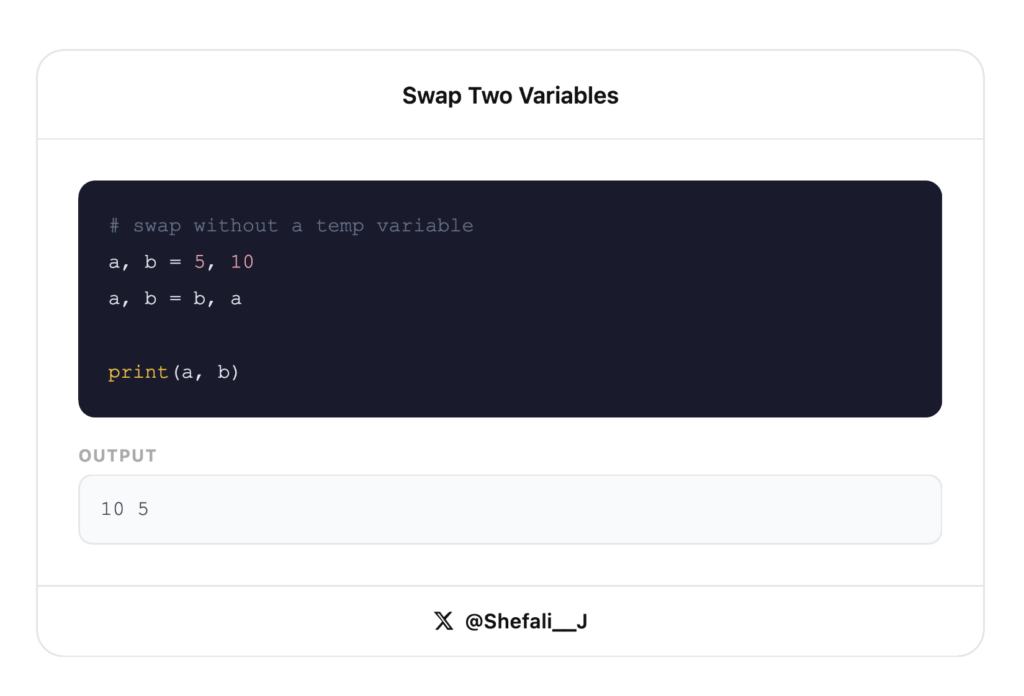
1. Swap Two Variables
You can swap the values of two variables in just one line. There’s no need to create a temporary variable.
a, b = 5, 10
a, b = b, a

print(a, b)  # 10 5
Python uses tuple unpacking to swap the values. It’s a simple and clean way to exchange values between two variables.
2. Reverse a List or String
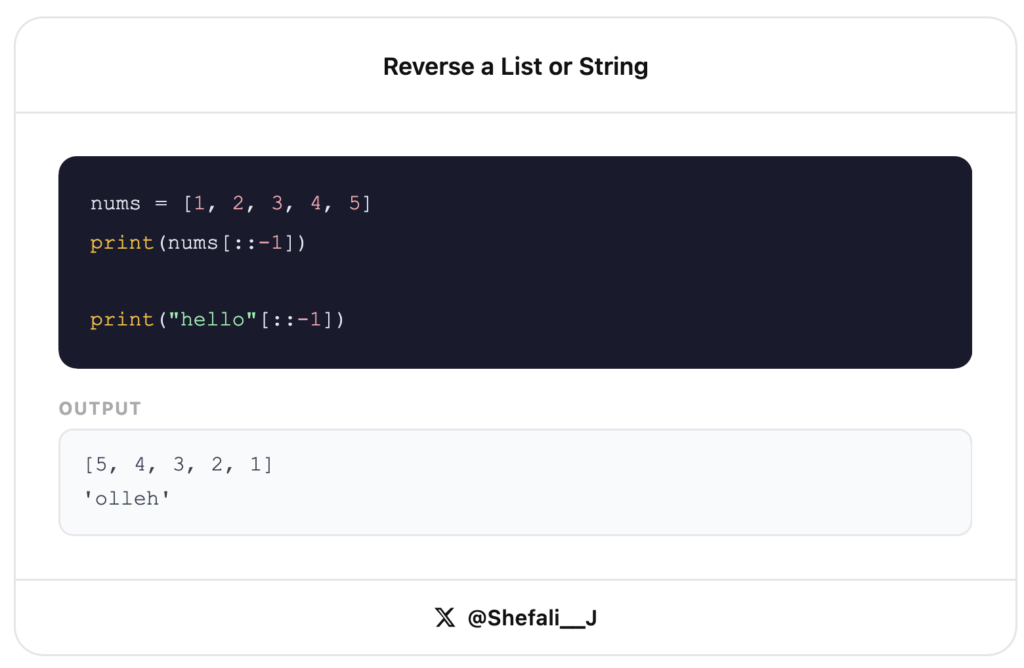
You can reverse a list or string using [::-1].
nums = [1, 2, 3, 4, 5]
print(nums[::-1])  # [5, 4, 3, 2, 1]

print("hello"[::-1])  # "olleh"
The [::-1] slice reads the sequence from the end to the beginning. It works with lists, strings, and tuples, so you don’t need a loop.
3. Flatten a Nested List
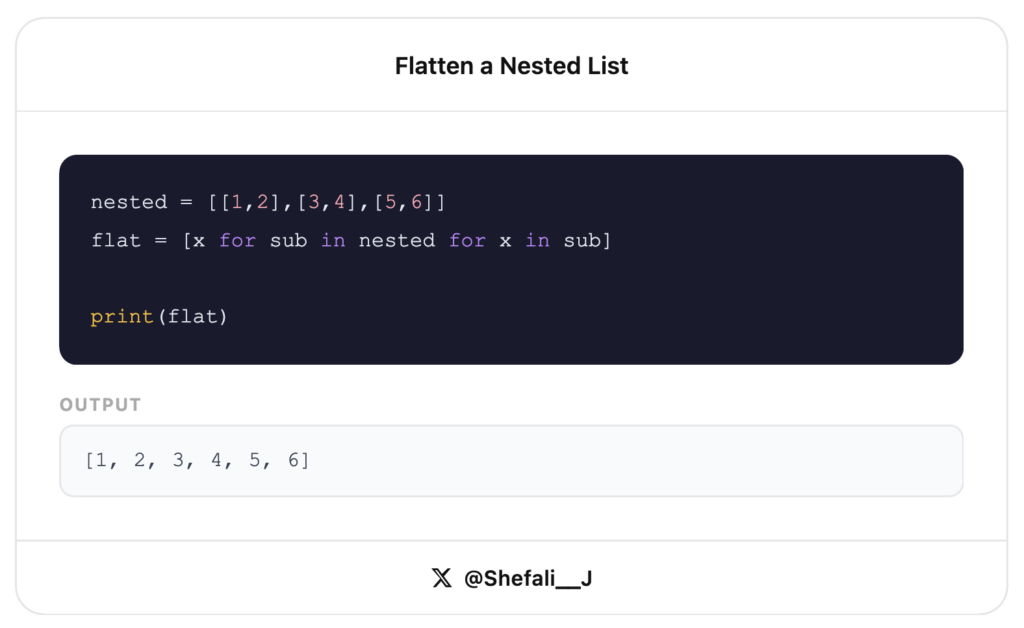
You can turn a nested list into a single list using a list comprehension.
nested = [[1, 2], [3, 4], [5, 6]]
flat = [x for sublist in nested for x in sublist]

print(flat)  # [1, 2, 3, 4, 5, 6]
The code goes through each sublist and adds every item x to the new list.
It may look a little confusing at first, but it’s a short and useful way to flatten a list with one level of nesting.
4. Count Occurrences in a List
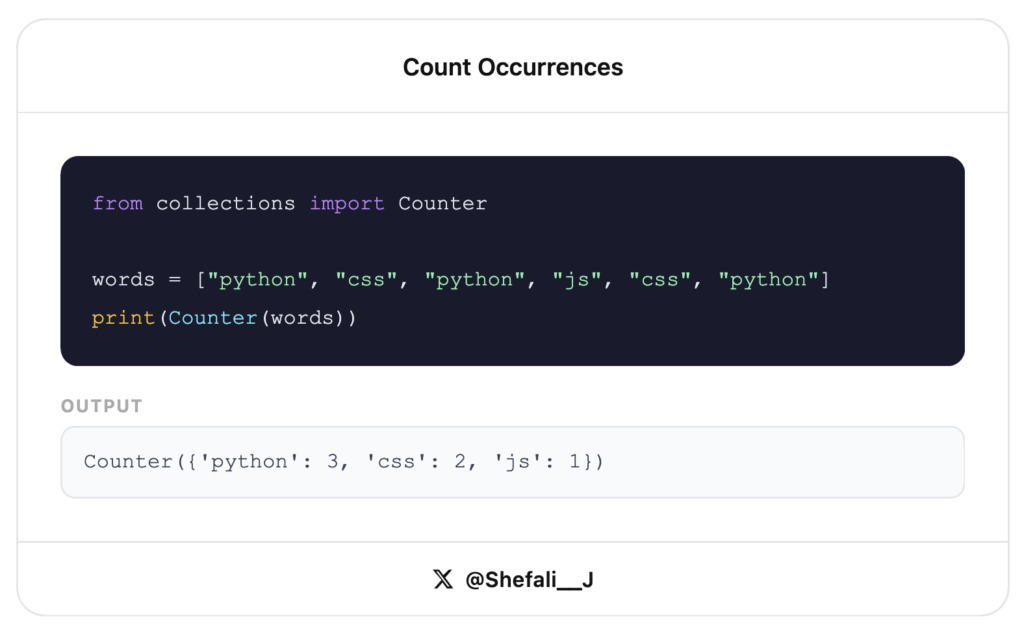
You can use Counter to quickly count how many times each item appears in a list.
from collections import Counter

words = ["python", "css", "python", "js", "css", "python"]
print(Counter(words))
# Counter({'python': 3, 'css': 2, 'js': 1})
Counter automatically counts each item and shows how many times it appears. You don’t need to write a loop or create a dictionary manually.
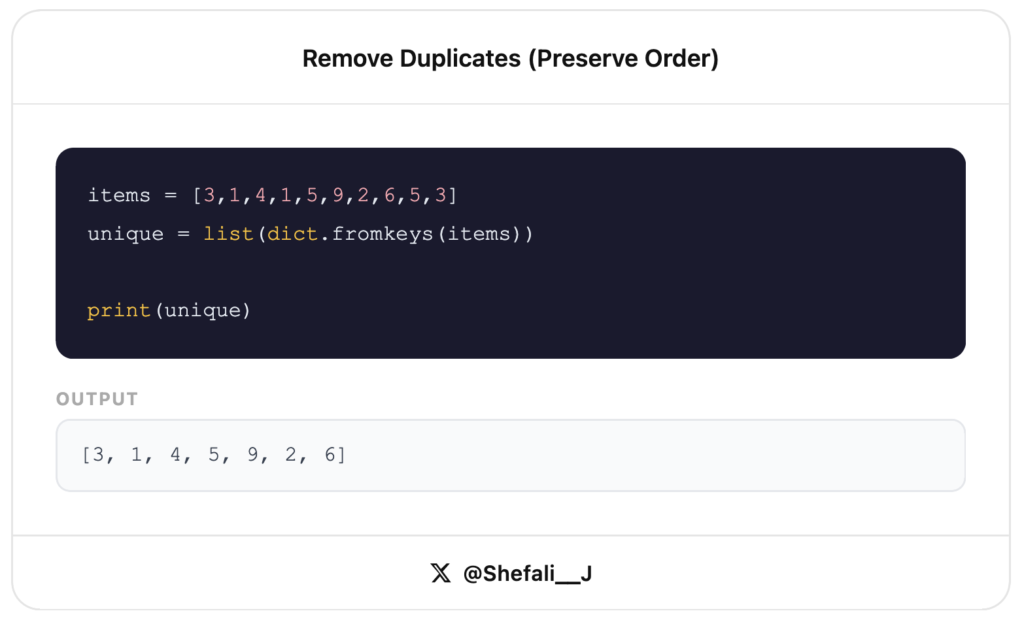
5. Remove Duplicates While Preserving Order
You can remove duplicate items from a list while keeping the original order using dict.fromkeys().
items = [3, 1, 4, 1, 5, 9, 2, 6, 5, 3]
unique = list(dict.fromkeys(items))

print(unique)  # [3, 1, 4, 5, 9, 2, 6]
Using set() also removes duplicates, but it doesn’t guarantee the original order. dict.fromkeys() keeps the items in the same order they first appeared.
6. Merge Two Dictionaries
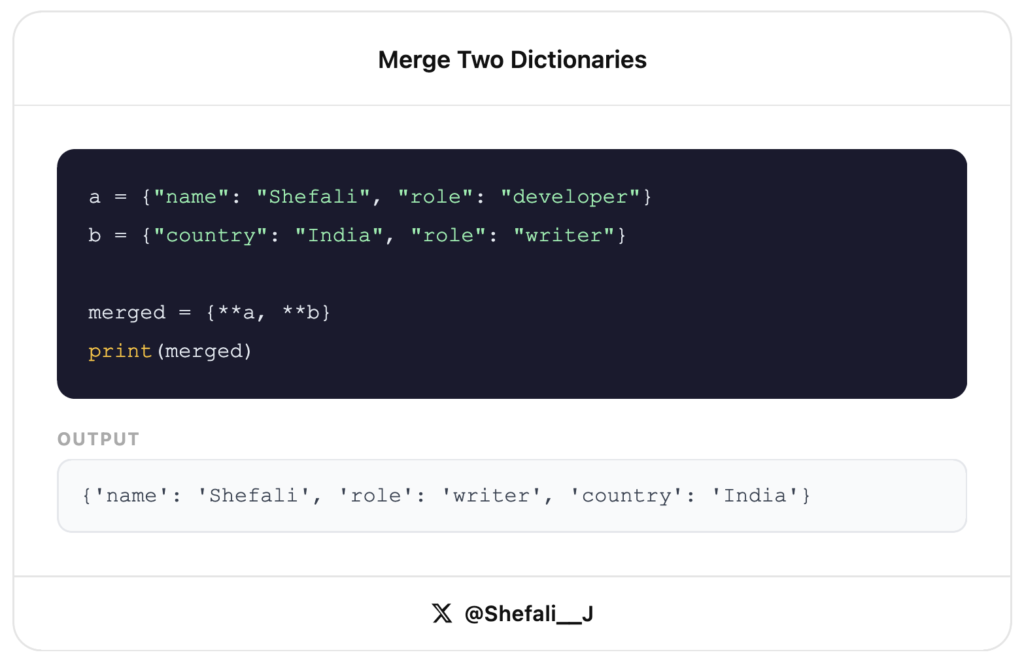
You can combine two dictionaries into one using the ** unpacking operator.
a = {"name": "Shefali", "role": "developer"}
b = {"country": "India", "role": "writer"}

merged = {**a, **b}
print(merged)
# {'name': 'Shefali', 'role': 'writer', 'country': 'India'}
The ** operator unpacks both dictionaries and combines their items. If the same key exists in both dictionaries, the value from the second dictionary is used.
7. Find the Most Frequent Element
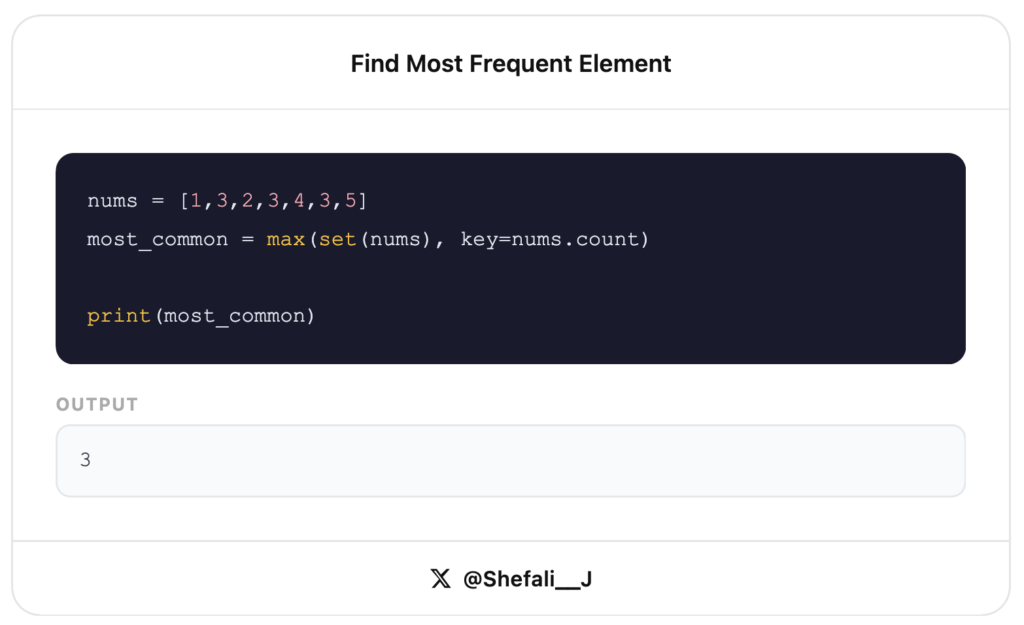
You can find the item that appears most often in a list using max().
nums = [1, 3, 2, 3, 4, 3, 5]
most_common = max(set(nums), key=nums.count)

print(most_common)  # 3
set(nums) gets the unique values, and nums.count counts how many times each value appears. max() then returns the value with the highest count.
8. Check if a String is a Palindrome
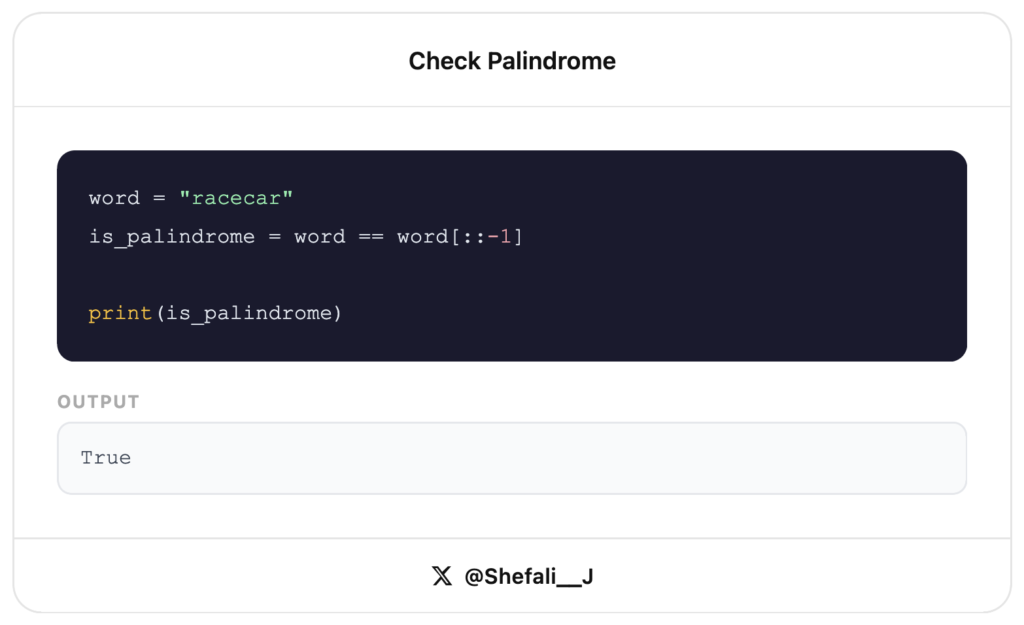
A palindrome is a word that reads the same forward and backward, like "racecar".
word = "racecar"
is_palindrome = word == word[::-1]

print(is_palindrome)  # True
This code reverses the word using [::-1] and compares it with the original word. If both are the same, the word is a palindrome.
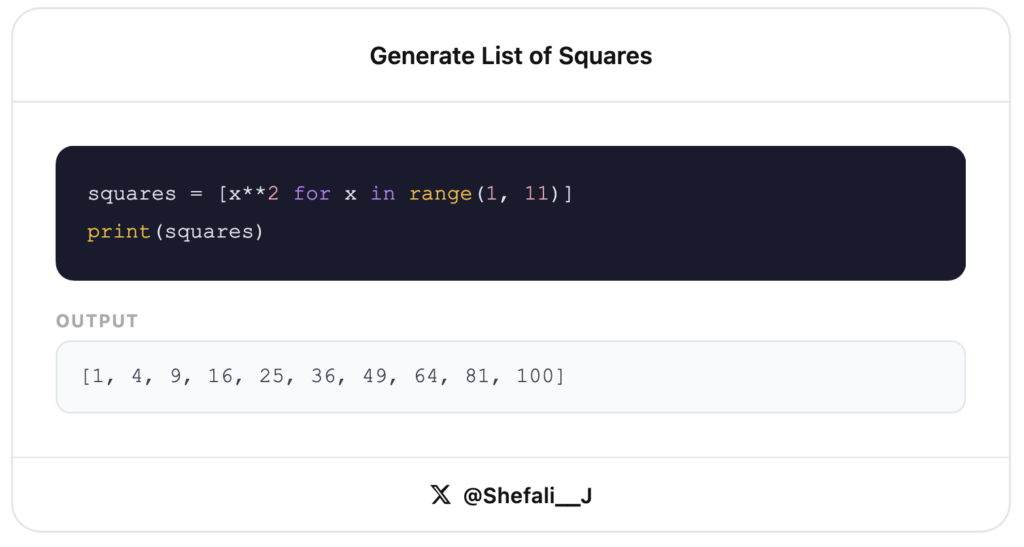
9. Generate a List of Squares
You can create a list of squares using a list comprehension.
squares = [x**2 for x in range(1, 11)]
print(squares)
# [1, 4, 9, 16, 25, 36, 49, 64, 81, 100]
The code goes through numbers from 1 to 10, squares each number, and adds the result to a new list.
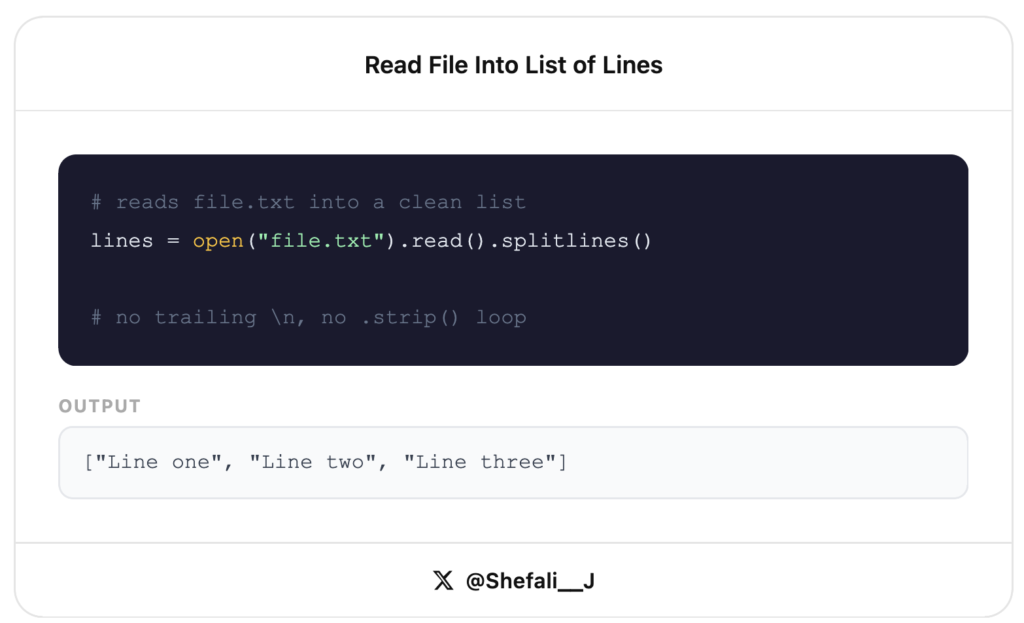
10. Read a File Into a List of Lines
You can read all the lines from a file and store them in a list in one line.
lines = open("file.txt").read().splitlines()
read() reads the file content, and splitlines() splits it into separate lines without keeping the newline characters.
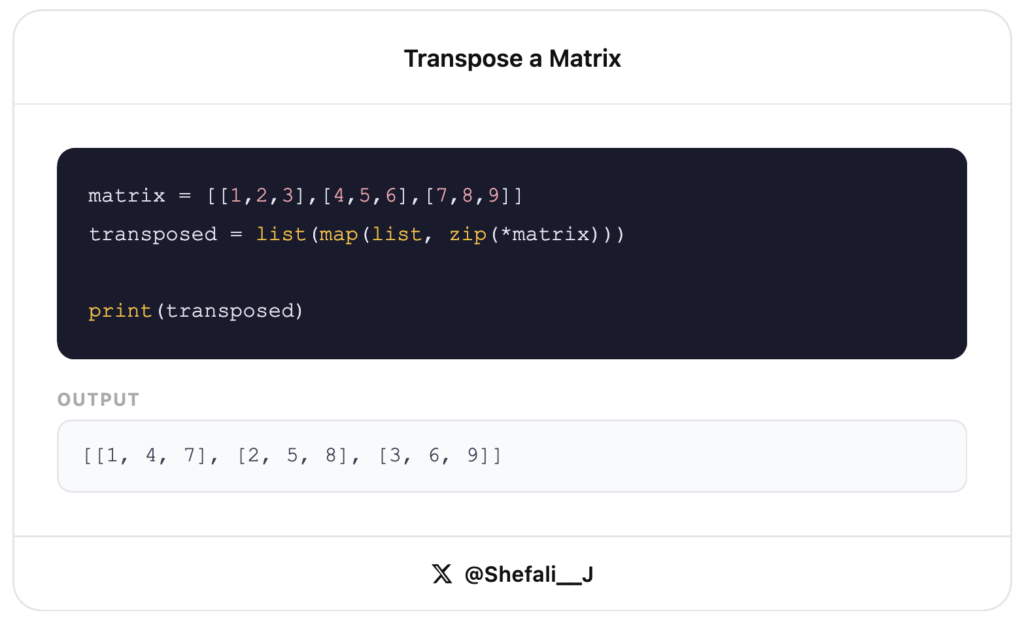
11. Transpose a Matrix
You can swap the rows and columns of a matrix using zip().
matrix = [[1, 2, 3], [4, 5, 6], [7, 8, 9]]
transposed = list(map(list, zip(*matrix)))

print(transposed)
# [[1, 4, 7], [2, 5, 8], [3, 6, 9]]
zip(*matrix) groups the values from each column together. map(list, ...) then converts each group into a list.
The result turns the rows of the original matrix into columns.
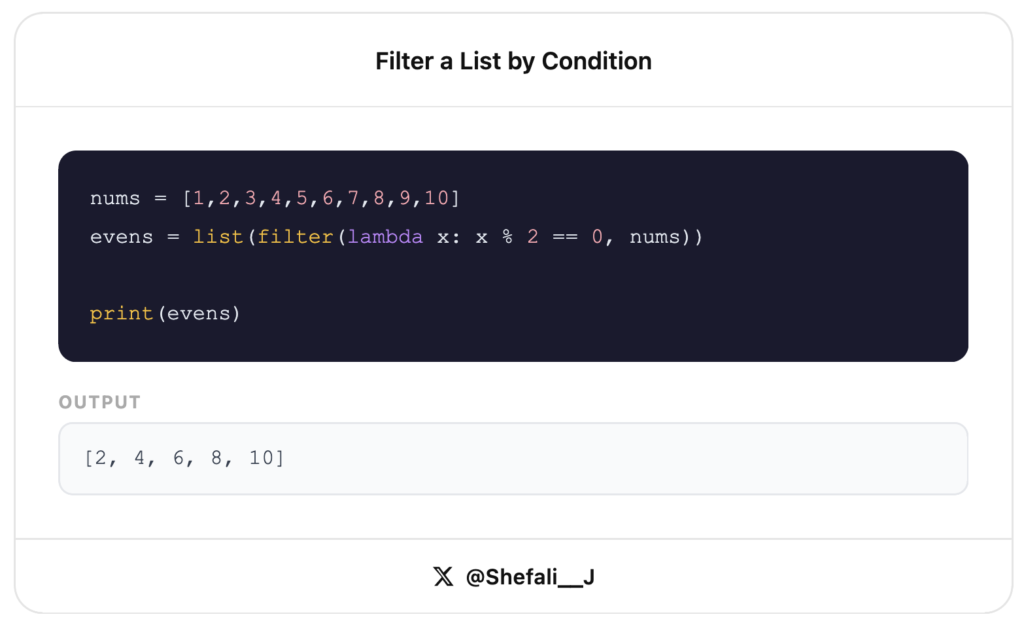
12. Filter a List by Condition
You can use filter() to keep only the items that match a condition.
nums = [1, 2, 3, 4, 5, 6, 7, 8, 9, 10]
evens = list(filter(lambda x: x % 2 == 0, nums))

print(evens)  # [2, 4, 6, 8, 10]
The lambda checks if each number is even. filter() keeps only the numbers that pass this condition.
You can also write the same code using a list comprehension:
evens = [x for x in nums if x % 2 == 0]
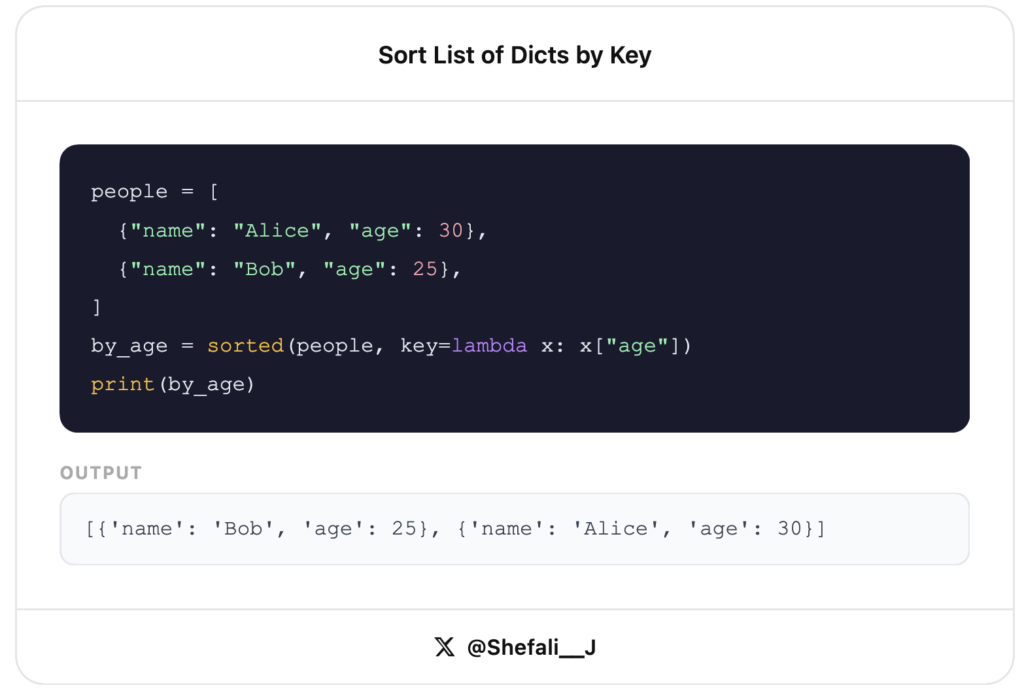
13. Sort a List of Dictionaries by Key
You can sort a list of dictionaries based on a specific value using sorted().
people = [
	{"name": "Alice", "age": 30},
	{"name": "Bob", "age": 25},
	{"name": "Carol", "age": 35}
]

sorted_people = sorted(people, key=lambda x: x["age"])
print(sorted_people)

# [{'name': 'Bob', 'age': 25}, {'name': 'Alice', 'age': 30}, {'name': 'Carol', 'age': 35}]
Here, the lambda tells sorted() to use the age value when sorting. The result is a list sorted from the youngest person to the oldest.
14. Create a Dictionary from Two Lists
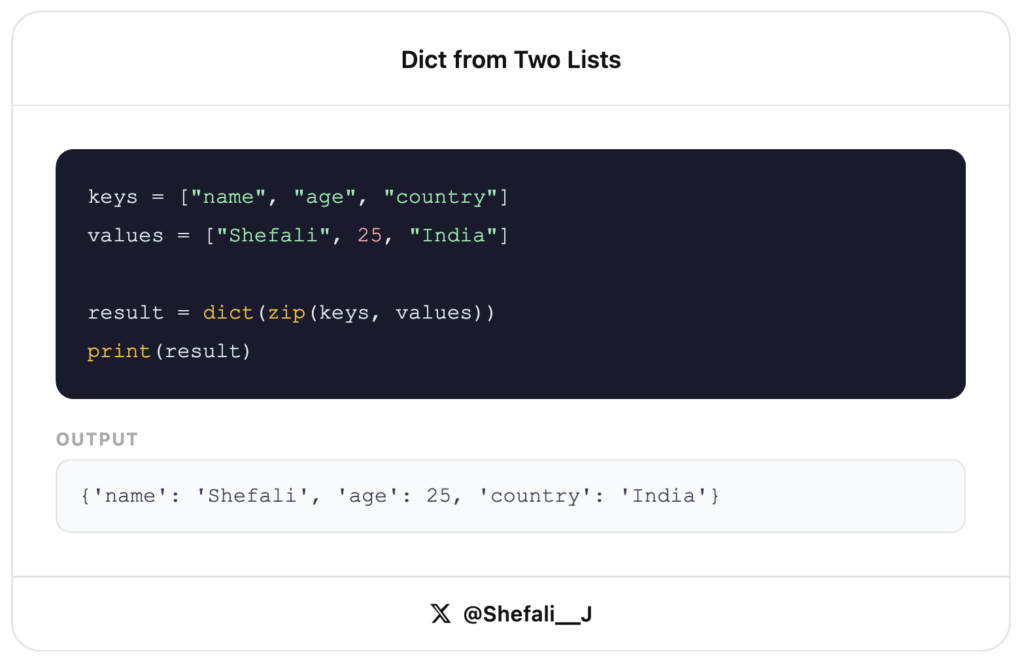
You can combine two lists to create a dictionary using zip() and dict().
keys = ["name", "age", "country"]
values = ["Shefali", 27, "India"]

result = dict(zip(keys, values))
print(result)
# {'name': 'Shefali', 'age': 27, 'country': 'India'}
zip() pairs each item from the keys list with an item from the values list. dict() then turns these pairs into a dictionary.
15. Find Items Unique to One List
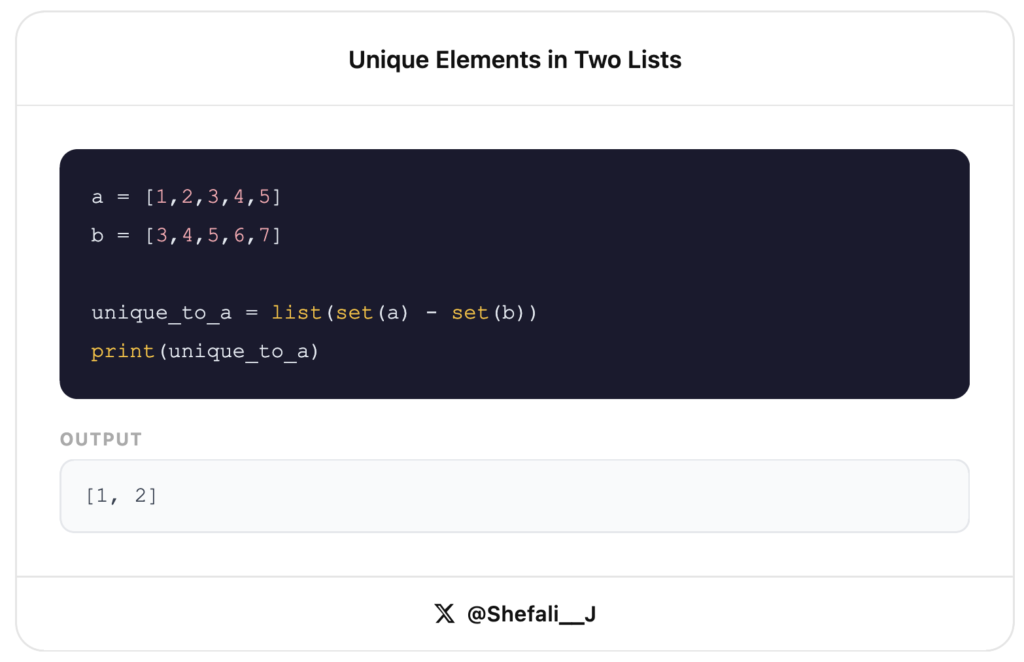
You can use sets to find items that exist in one list but not in another.
a = [1, 2, 3, 4, 5]
b = [3, 4, 5, 6, 7]

unique_to_a = list(set(a) - set(b))
print(unique_to_a)  # [1, 2]
The - operator finds the difference between two sets. In this example, it returns the items that are in a but not in b.
You can also use & to find common items and | to combine items from both sets.
16. Find All Indices of an Element
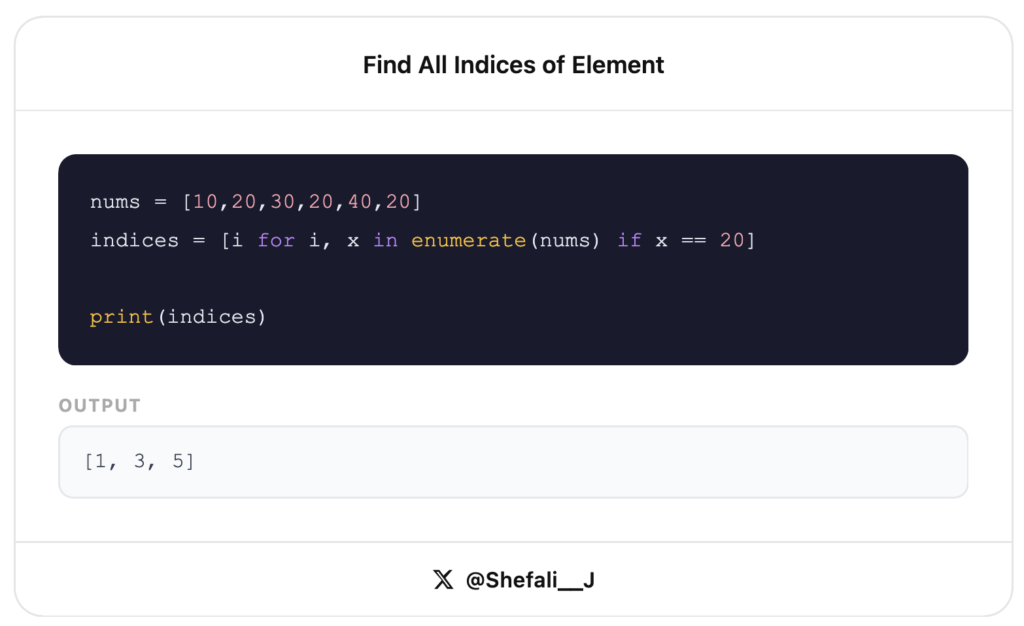
You can find every position where an item appears using enumerate().
nums = [10, 20, 30, 20, 40, 20]
indices = [i for i, x in enumerate(nums) if x == 20]

print(indices)  # [1, 3, 5]
enumerate() gives you both the index and value of each item. The condition then keeps only the indices where the value is 20.
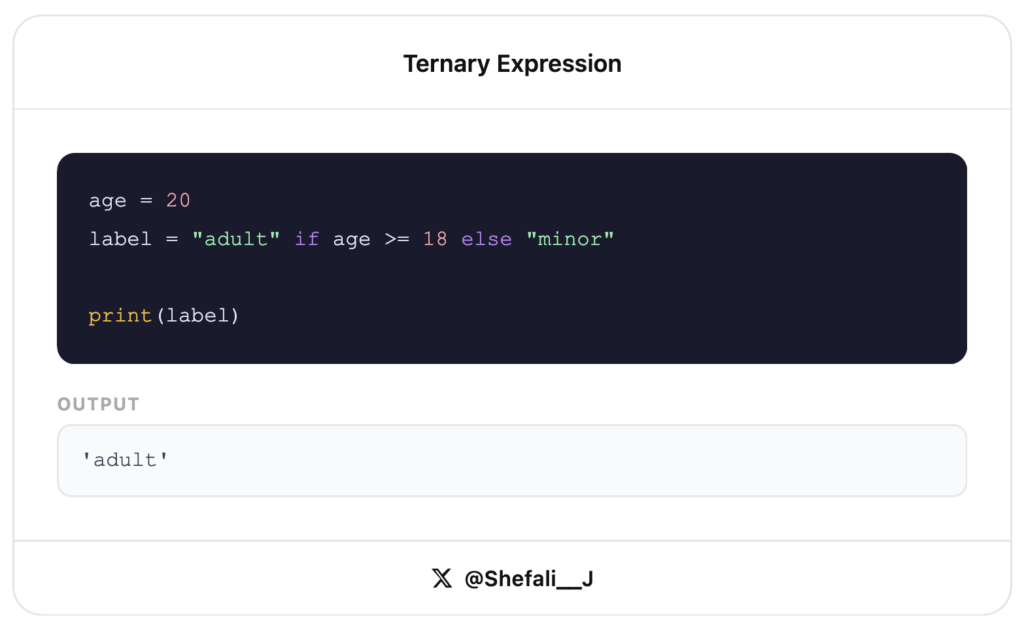
17. Ternary Expression
You can write a simple if-else condition in one line using a ternary expression.
age = 20
label = "adult" if age >= 18 else "minor"

print(label)  # "adult"
If age is 18 or more, label becomes "adult". Otherwise, it becomes "minor".
This is useful for short and simple conditions.
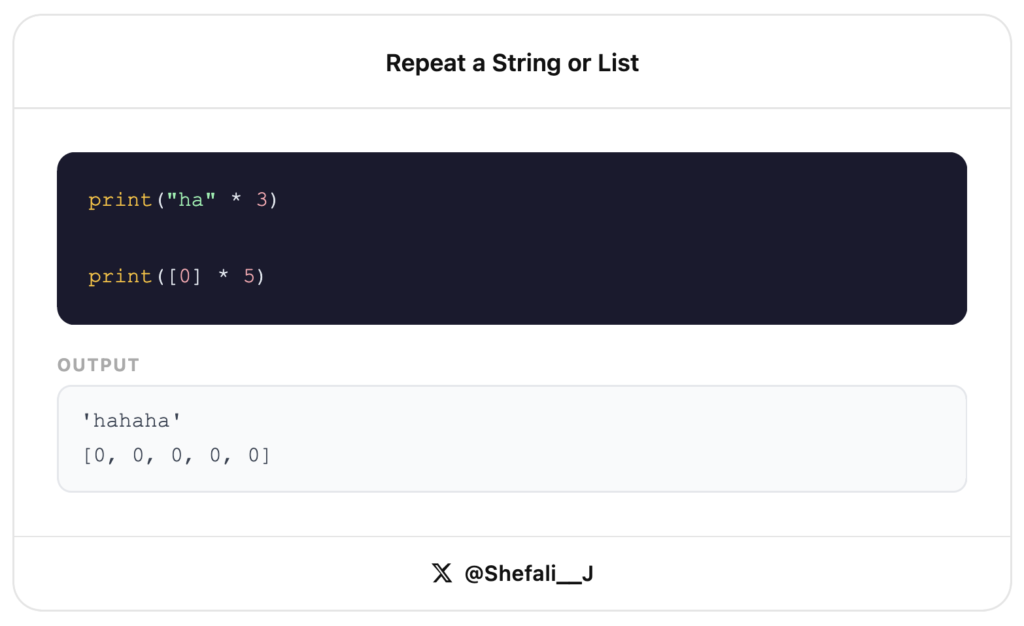
18. Repeat a String or List
You can use the * operator to repeat a string or list.
print("ha" * 3)        # "hahaha"
print([0] * 5)         # [0, 0, 0, 0, 0]
Multiplying a string repeats its text, while multiplying a list repeats its items.
This is a quick way to create repeated values.
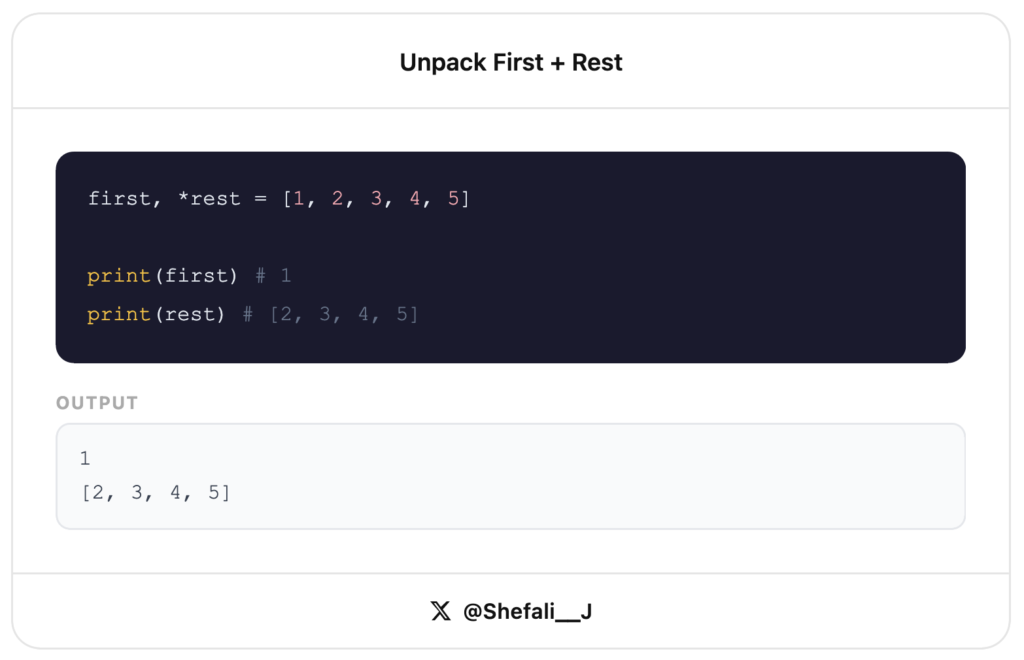
19. Unpack a List Into First and Rest
You can store the first item separately and collect the remaining items in another variable.
first, *rest = [1, 2, 3, 4, 5]

print(first)  # 1
print(rest)   # [2, 3, 4, 5]
The *rest variable collects all the remaining items into a list.
You can also use *init, last if you want to store the last item separately.
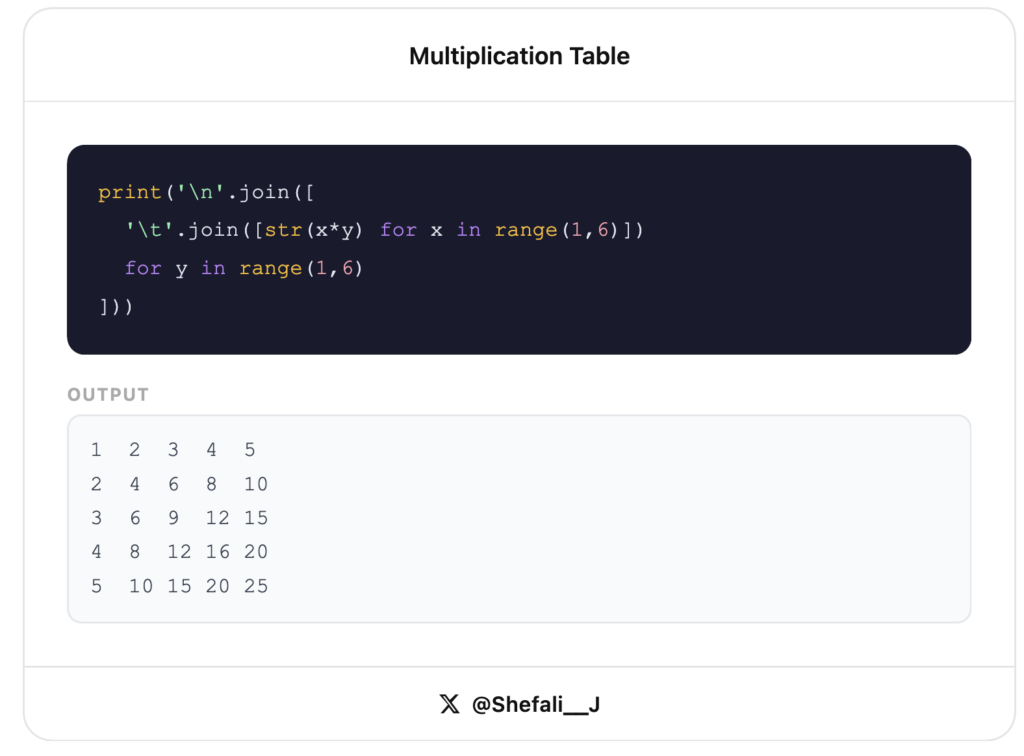
20. Print a Multiplication Table
You can create a complete 10×10 multiplication table in one line.
print('\n'.join(['\t'.join([str(x*y) for x in range(1, 11)]) for y in range(1, 11)]))
The inner list comprehension multiplies the numbers in each row. '\t'.join() separates the values with tabs, while '\n'.join() puts each row on a new line.
It’s a compact way to generate an entire multiplication table with one line of Python.
That’s all for today!
I hope you found these Python one-liners useful and learned a few new tricks.
If you enjoy my work and want to support what I do, buy me a coffee!
Every small gesture keeps me going! 💛
Follow me on X (Twitter) to get daily web development tips & insights.
Enjoyed reading? You may also find these articles helpful.
The Ultimate Python Roadmap: Learn Step by Step